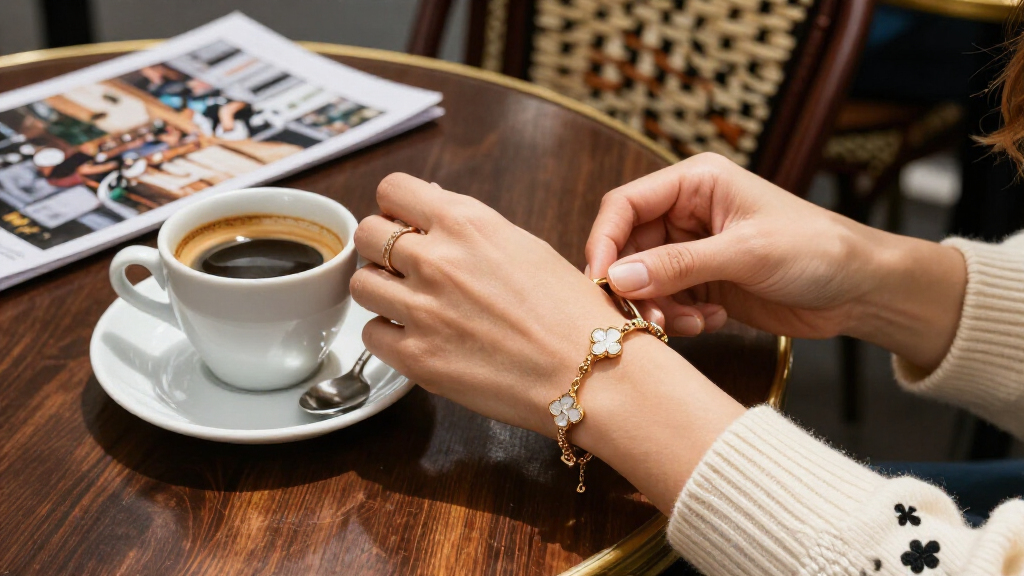

Choosing the best Van Cleef & Arpels jewelry starts with a distinction that matters: the listings here do not all provide verified product specifications, and one is a gold-plated, cubic-zirconia clover necklace rather than a documented Van Cleef & Arpels piece. I rank the adjustable necklace first for shoppers who want the clearest description and an accessible, everyday clover look. The brand listings may appeal to buyers seeking the Van Cleef & Arpels name, but their sparse details make it difficult to compare materials, dimensions, or construction.

Get your wardrobe favorites delivered free with Prime
- Fast, free delivery on millions of items
- Prime Video, Amazon Music and more included
- Member-only deals all year
My ranking weighs what the listing actually tells a buyer, how clearly the piece’s materials and fit are described, and whether the available information supports a confident choice. The central tradeoff is straightforward: the necklace listing offers practical specifics but does not establish that it is authentic Van Cleef & Arpels jewelry; the brand-named listings connect more directly to the luxury house but lack the product-level information needed to judge the individual pieces. I would treat that gap as a reason to ask questions before ordering, not as proof of a particular material or design.
Key Takeaways
Most clearly described: The Dainty Four-Leaf Clover Gold-Plated Necklace lists a brass base, 14K gold plating, cubic zirconia, and a 16-inch chain with a 2-inch extension.
Best match for Van Cleef & Arpels brand intent: The four brand-named listings are more directly relevant to shoppers seeking the house, but the supplied details do not establish exact models, materials, or authenticity.
Main distinction: The clover necklace offers a similar broad motif, not evidence of a Van Cleef & Arpels design or an official house product.
Biggest information gap: Three of the brand-named entries have no product description or specifications, so their individual merits cannot be compared reliably.
Buyer rule: Before choosing a brand-named listing, seek the exact model name, material details, dimensions, condition, and clear evidence of provenance.
| Dainty Four-Leaf Clover Gold-Plated Necklace for Women |  | Best for a clearly specified clover look | Base material: Brass | Plating: 14K gold | Pendant: Four-leaf clover with cubic zirconia stones | VIEW LATEST PRICE | See Our Full Breakdown |
| Van Cleef & Arpels |  | Best brand-named listing with some house context | Brand named: Van Cleef & Arpels | Product type: Not specified | Model or collection: Not specified | VIEW LATEST PRICE | See Our Full Breakdown |
| Van Cleef & Arpels |  | Best for shoppers willing to request missing details | Brand named: Van Cleef & Arpels | Product type: Not specified | Design: Not specified | VIEW LATEST PRICE | See Our Full Breakdown |
| Van Cleef & Arpels |  | Best for buyers who already know what item they want | Brand named: Van Cleef & Arpels | Product category: Not specified | Model: Not specified | VIEW LATEST PRICE | See Our Full Breakdown |
| Van Cleef & Arpels |  | Best for buyers who prioritize seller clarification over listing detail | Brand named: Van Cleef & Arpels | Jewelry type: Not specified | Design or collection: Not specified | VIEW LATEST PRICE | See Our Full Breakdown |
| Van Cleef & Arpels jewelry | Brand named | Materials |
|---|---|---|
| Dainty Four-Leaf Clover Gold-P | — | — |
| Van Cleef & Arpels | Van Cleef & Arpels | Not specified |
| Van Cleef & Arpels | Van Cleef & Arpels | Not specified |
| Van Cleef & Arpels | Van Cleef & Arpels | — |
| Van Cleef & Arpels | Van Cleef & Arpels | Not specified |
More Details on Our Top Picks
Dainty Four-Leaf Clover Gold-Plated Necklace for Women
This is the most straightforward choice in the lineup for a buyer who wants a four-leaf clover pendant and practical information before ordering. The listing specifies a brass base with 14K gold plating, cubic zirconia accents, a cable chain, a lobster clasp, and an adjustable length of 16 inches plus a 2-inch extension. That level of detail makes it easier to judge fit and styling than any of the four brand-named entries, whose supplied information does not identify a specific model or give comparable specifications.
The adjustable chain is useful if you want the pendant to sit at different points with a neckline or layer it with another necklace. Its stated materials also set a clear expectation: gold-plated brass and cubic zirconia, not solid gold or a documented Van Cleef & Arpels piece. The clover motif may appeal to shoppers looking for a similar broad design cue, but the supplied information does not support calling it an official house design or a substitute for one.
The tradeoff is material and provenance, not a lack of description. Brass may be a poor fit for a buyer specifically seeking precious-metal jewelry, and the listing does not provide independent confirmation of durability, waterproof performance, or tarnish resistance. Compared with the brand-named entries, this necklace is easier to evaluate as a particular object; compared with authenticated luxury jewelry, it does not offer the stated brand identity or verified house craftsmanship. I would choose it for a defined look and adjustable everyday styling, not for brand collectability.
Pros:- Lists the base metal, plating, and cubic zirconia accents.
- 16-inch chain with a 2-inch extension allows some fit adjustment.
- Clover motif and polished gold-colored finish suit layering or dressier outfits.
- Lobster clasp and cable chain are clearly identified.
Cons:- Brass base is not solid gold, and the listing does not establish luxury-house craftsmanship.
- Waterproof and tarnish-resistant performance is not independently specified.
- The shared clover motif does not show affiliation with Van Cleef & Arpels.
Best for: Shoppers who want a specified clover pendant, adjustable chain, and gold-colored finish without needing documented Van Cleef & Arpels provenance.
Not ideal for: Buyers seeking solid gold, precious stones, or a confirmed authentic Van Cleef & Arpels piece.
- Base material:Brass
- Plating:14K gold
- Pendant:Four-leaf clover with cubic zirconia stones
- Stone description:AAA+ cubic zirconia, as stated in the listing
- Chain:Cable chain
- Clasp:Lobster clasp
- Chain length:16 inches plus 2-inch extension
- Nickel and lead:Described as nickel-free and lead-free
Our verdict“I rank this first for its unusually clear specifications, while treating it as a gold-plated clover necklace rather than verified Van Cleef & Arpels jewelry.”
Van Cleef & Arpels
This listing has a small informational advantage over the other brand-named entries because its description identifies Van Cleef & Arpels as a French luxury jewelry, watch, and perfume house and mentions an elegant, enduring design approach. That background speaks to why a buyer might seek the brand, but it does not identify the specific jewelry item being sold. No model, collection, metal, stone, dimensions, or condition is supplied, so I cannot judge whether the actual product suits a particular wardrobe or budget.
Compared with the adjustable clover necklace, this entry is more directly connected by name to the house but far less useful for evaluating the object. Compared with the other three brand-only listings, it at least gives a general description of the company. That should not be mistaken for evidence about the listed piece’s materials, authenticity, or craftsmanship. The difference between brand background and product documentation is the deciding point here.
I would place it on a shortlist only if the seller can provide details absent from the supplied listing: the exact design name, clear photos from multiple angles, material and stone information, condition, and reliable provenance. Without those answers, a buyer cannot distinguish a pendant from a ring, determine scale, or know what is included. This listing makes more sense for someone already in contact with a seller and seeking clarification than for a shopper expecting a complete product page. Its ranking reflects modestly better context, not a verified quality advantage over the blank brand entries.
Pros:- Names the luxury house and provides brief brand context.
- More descriptive context than the brand-only entries with blank descriptions.
- May be relevant to shoppers already seeking the house’s jewelry.
- The listing can serve as a starting point for questions about the exact item.
Cons:- No specific jewelry model, collection, material, or dimensions are provided.
- The available description does not verify authenticity or provenance.
- A buyer cannot assess fit, condition, or stone details from the supplied information.
Best for: A shopper specifically searching for Van Cleef & Arpels who can obtain exact item details and provenance directly from the seller before purchasing.
Not ideal for: Buyers who need clear specifications, a named model, or documented authenticity from the listing itself.
- Brand named:Van Cleef & Arpels
- Product type:Not specified
- Model or collection:Not specified
- Materials:Not specified
- Stones:Not specified
- Dimensions:Not specified
- Condition and provenance:Not specified
Our verdict“I rank this above the blank brand listings for its limited house context, but I would not buy without item-specific details and provenance.”
Van Cleef & Arpels
This listing is aimed at the most direct brand search, but the supplied entry contains only the name Van Cleef & Arpels. It does not say whether the item is a necklace, bracelet, ring, or another jewelry type. There is no design name, material, stone, length, condition, or provenance information. That makes it impossible to compare the object itself with the clover necklace or with the more descriptive brand-named listing.
Its only practical distinction in this roundup is the gap between brand relevance and product clarity. If your priority is finding a listing associated with the house, the title may catch your attention; if your priority is knowing what you are buying, it leaves essential questions unanswered. The adjustable necklace is far easier to evaluate as a wearable item, though it is not represented as Van Cleef & Arpels. The B0HJMB3D9L entry gives more general context, while this one supplies no comparable description.
I would treat this as a request-information-first option, not as a recommendation based on the title alone. Ask for the exact model, material marks or documentation, close-up photographs, dimensions, condition, and an explanation of provenance. If those details are unavailable, there is no sound basis to judge whether the item matches your preferences or whether the listing accurately describes it. The low information level is the main drawback, and it keeps this entry below the one with at least some house context.
Pros:- The title directly names the house sought by brand-focused shoppers.
- Could prompt a seller conversation that clarifies the product.
- Does not make unsupported claims about specific materials in the supplied description.
Cons:- No product description or specifications are supplied.
- The jewelry category and exact model are unknown.
- Authenticity, condition, materials, and provenance cannot be evaluated from the listing details.
Best for: Experienced luxury-jewelry shoppers who can contact the seller and independently verify the exact piece before committing.
Not ideal for: First-time buyers or anyone who expects a listing to identify the jewelry type, materials, and condition.
- Brand named:Van Cleef & Arpels
- Product type:Not specified
- Design:Not specified
- Materials:Not specified
- Stone details:Not specified
- Dimensions:Not specified
- Condition:Not specified
Our verdict“I would consider this only after the seller supplies specific item details and credible provenance, since the title alone does not identify the jewelry.”
Van Cleef & Arpels
Among these entries, this is another brand-only listing with no product description or specifications. That leaves the central shopping questions open: what kind of jewelry is offered, which design it follows, what it is made from, and what condition it is in. The title alone cannot tell a buyer whether the item is a clover motif or a different design, so I cannot use the brand name to infer details that are not supplied.
Compared with B0HJMB3D9L, this entry lacks even the brief general background about the house. Compared with B0HJSXSVBG and B0HD7SR35D, the available information offers no product-level distinction at all. The necklace listing is the opposite in one important way: it spells out its materials and chain length, although it does not establish Van Cleef & Arpels affiliation. These listings therefore answer different needs, and neither should be treated as a direct substitute for the other.
This may be workable for someone who already has an exact model in mind and can use a seller conversation to establish what is offered. I would ask for item-specific photographs and documentation, not just a general assurance that the item is from the house. Confirm the design name, materials, dimensions, condition, and available provenance before deciding. With no such information in the supplied entry, the listing is not a good fit for a buyer comparing styles or assessing jewelry remotely.
Pros:- The title is relevant to searches for the named jewelry house.
- Could be useful if the seller can provide an exact model and documentation.
- Leaves room for a buyer to clarify details before purchase.
Cons:- No description, model name, materials, or measurements are provided.
- The listing does not establish whether the item is jewelry or identify its form.
- No condition or authenticity information is supplied.
Best for: A brand-focused buyer who knows the particular item they are seeking and can confirm all details with the seller.
Not ideal for: Shoppers comparing designs, materials, or fit from the product page, especially buyers new to luxury jewelry.
- Brand named:Van Cleef & Arpels
- Product category:Not specified
- Model:Not specified
- Metal:Not specified
- Stones:Not specified
- Measurements:Not specified
- Documentation:Not specified
Our verdict“I would shortlist this only if I already knew the exact piece and could verify its details outside the supplied listing.”
Van Cleef & Arpels
This entry provides no description beyond the brand name and no specifications. It is consequently the hardest of the five to assess: there is no stated product type, design, metal, stone, size, condition, or provenance. I cannot tell whether it has any feature that makes it preferable to the other brand-only listings, and I would not assign it a particular collection or motif based on the title.
In the lineup, B0HJMB3D9L edges ahead because its supplied copy at least describes the house in general terms. B0HJSXSVBG and B0H8K7NL46 are similarly sparse. Against all three, the clover necklace has the practical advantage of named materials and dimensions, but it does not fulfill the same brand-authenticity aim. That distinction matters: more complete listing details help a buyer evaluate a piece, while a brand name alone does not establish what the item is.
I would approach this as a lead for a conversation rather than a finished product listing. Ask the seller to identify the exact jewelry piece and provide clear, current images, dimensions, material details, condition notes, and provenance documentation. If the answers remain vague, I would move on to an item with stronger evidence. This pick ranks last not because I can judge the jewelry negatively, but because there is too little information to judge it at all.
Pros:- The brand name may be relevant to a shopper’s search.
- A seller response could supply details not included in the provided listing.
- No unprovided model or material claims are made in the supplied description.
Cons:- No product description or specifications are available.
- The exact jewelry type, design, and dimensions are unknown.
- No evidence of condition, materials, or provenance is provided.
Best for: A patient buyer prepared to request full product information and verify provenance before considering the listing.
Not ideal for: Anyone who wants to make a confident choice from the listing as presented or compare it with named designs.
- Brand named:Van Cleef & Arpels
- Jewelry type:Not specified
- Design or collection:Not specified
- Materials:Not specified
- Stone details:Not specified
- Size:Not specified
- Provenance:Not specified
Our verdict“This is the least assessable option in my ranking, so I would proceed only after receiving clear product details and credible provenance.”
How We Picked
I ranked these five listings by how well the available information helps a buyer choose Van Cleef & Arpels jewelry, rather than by filling gaps with assumptions. The key editorial question was whether each entry gives enough product-level evidence to assess the piece itself: a named design, stated materials, dimensions, condition, or other distinguishing details. Only the clover necklace has a supplied set of concrete product specifications. One brand-named entry offers general background about the house, but it does not identify a specific piece or substantiate its construction.
That means this is an information-quality ranking, not a claim that one undocumented brand listing is better made or more desirable than another. I placed the necklace first because a buyer can at least understand its brass base, gold plating, cubic zirconia accents, chain length, and intended versatility. It remains a different proposition from verified Van Cleef & Arpels jewelry. I ranked the brand-named entries next, giving the one with a little more descriptive context a slight informational advantage and treating the otherwise blank listings as difficult to distinguish.
I also considered design relevance and practical tradeoffs. A clover motif may suit shoppers drawn to the visual language associated with Van Cleef & Arpels, but a shared motif does not establish brand affiliation, authenticity, or equivalence in craftsmanship. Gold plating over brass is not solid gold, while cubic zirconia is not the same material as a precious gemstone. For brand listings without specifications, I do not infer metal, stones, collection, size, or provenance from the title alone.
Before buying any listing that uses a luxury brand name without identifying the item, I would request the exact model and supporting documentation, along with clear photos and confirmation of condition. I would also check the seller’s return terms and whether the stated product details match the item being offered. These checks matter especially when the listing provides little more than a brand name. Where information is absent, I mark that as a buyer-facing drawback instead of presenting it as a hidden advantage.
Factors to Consider When Choosing Best Van Cleef & Arpels Jewelry
When choosing jewelry under a Van Cleef & Arpels search, I separate brand identity, design preference, and listing evidence. A clover-like motif may suit your style, but it does not establish that a piece comes from the house. A brand-name title may be relevant, but it is not enough to identify the actual jewelry. I would compare the item-level details first and treat missing information as a reason to pause.
Decide whether brand provenance or motif matters more
If your priority is a confirmed Van Cleef & Arpels piece, focus on exact model identification and provenance, not just a title containing the brand name. The four brand-named listings in this comparison do not provide the information needed to identify an individual jewelry item. Ask what the exact design is and request documentation or other credible evidence tied to the item offered. If what attracts you is simply a four-leaf clover look, the adjustable necklace is more clearly described, but its listing specifies a different proposition: brass, 14K gold plating, and cubic zirconia, with no stated house affiliation.
This distinction helps prevent a common mismatch between search and purchase. A style resemblance is not proof of origin, and brand language by itself does not show that a product is authentic. I would choose based on the reason I am shopping: for a particular house and its documented piece, verify identity; for a broad clover-inspired look, compare the actual materials, scale, and fit.
Read material claims as construction details
The necklace listing states brass with 14K gold plating and cubic zirconia. That tells you more than a vague gold-colored description, but it does not mean the piece is solid gold or set with precious stones. Buyers seeking a precious-metal item should not treat plating as an equivalent. The product entries for the brand-named listings do not state materials at all, so I cannot compare their metal or stone construction with the necklace.
When a listing omits materials, ask for a clear written answer and any supporting marks or documentation relevant to the particular item. Also ask how the seller describes the stones and whether the item is new or pre-owned. For the clover necklace, the listing calls it nickel-free and lead-free, but its durability and water exposure guidance are not independently specified here. I would follow care guidance supplied with the item rather than assume plating will withstand daily moisture or friction.
Check fit, scale, and how you plan to wear it
The clover necklace is the only option here with a stated chain length: 16 inches plus a 2-inch extension. The extension gives some flexibility for layering or adjusting the pendant’s position, which is more useful than a fixed, unspecified length when coordinating with different necklines. The listing does not provide a clear pendant dimension in the supplied specs, however, so ask for measurements if scale is important to you.
The brand-named listings provide no dimensions or even product categories. That makes them difficult to assess for everyday wear, stacking, or gifting. Ask for measurements in a consistent unit and request photos that show the piece beside a ruler or on a person, while remembering that images can distort scale. For rings or bracelets, request the relevant size and adjustment range; for earrings, confirm dimensions and closure type. A design you like can still be the wrong choice if its proportions or fit do not suit your use.
Treat missing listing details as a decision point
Three brand-named entries have no supplied description or specifications, and the remaining brand-named listing offers general background rather than details of a particular product. That is a significant contrast with the necklace listing, which identifies its materials and chain construction. I do not take sparse information as proof that an item is poor quality, but it leaves buyers with more verification work and less basis for comparison.
Before moving forward with an underspecified brand listing, ask for the exact model or collection, front and back photographs, dimensions, material and stone details, condition, what is included, and provenance. Check that the seller’s answers are consistent across the listing and any supporting records. If the response does not resolve the core questions, choosing an item with clearer information may be the safer decision, even if it offers a different design or brand proposition.
Match the choice to your reason for buying
For personal styling, prioritize the motif, proportions, materials, and comfort you actually want. The clover necklace is the clearest choice for someone seeking an adjustable, gold-colored clover pendant and who accepts plated brass and cubic zirconia. For collecting, gifting, or buying specifically into the house’s identity, the brand-named entries need substantial clarification before they can be compared. Their titles alone do not reveal whether an item is suitable for a particular recipient or occasion.
I would also think about the consequence of getting the details wrong. A casual style purchase may depend most on fit and appearance; a luxury-brand purchase places greater weight on identity, documentation, and seller clarity. Confirm return conditions and what is included before ordering, especially if the listing’s product information is incomplete. Those checks do not replace authentication, but they help expose gaps before they become a costly surprise.
Frequently Asked Questions
Is the Dainty Four-Leaf Clover Gold-Plated Necklace a Van Cleef & Arpels piece?
The supplied product description identifies a brass necklace with 14K gold plating and cubic zirconia, but it does not identify Van Cleef & Arpels as its maker or establish any house affiliation. Its clover motif is a broad design feature, not evidence of brand origin. I would treat it as a gold-plated clover necklace unless the seller provides reliable documentation establishing otherwise.
Which listing is easiest to evaluate from the information provided?
The Dainty Four-Leaf Clover Gold-Plated Necklace is easiest to evaluate because its listing gives a base metal, plating, stone type, clasp, chain style, and chain length. That information still leaves questions, including the pendant’s precise dimensions and long-term wear performance. The brand-named listings provide little or no product-level detail, so they require direct clarification before a fair comparison is possible.
What should I ask before buying one of the brand-named listings?
Ask for the exact product name or model, the type of jewelry, clear photographs, dimensions, materials, stone details, and condition. If authenticity matters to your purchase, request credible provenance or documentation connected to the specific item rather than relying on the title alone. I would also confirm what is included and review the seller’s return terms before deciding.
Does gold plating mean the clover necklace is solid gold?
No. The listing describes a brass base plated with 14K gold, which is different from solid gold. It also identifies the accents as cubic zirconia rather than naming a precious gemstone. Buyers seeking solid gold or a particular gemstone should look for those materials to be stated clearly and ask for supporting details when they are not.
How should I choose between the clover necklace and a brand-named listing?
Choose the necklace if your priority is a clearly described, adjustable clover design and you are comfortable with plated brass and cubic zirconia. Choose a brand-named listing only if the seller can identify the exact item and supply enough evidence for you to evaluate its materials, condition, and provenance. The necklace is easier to assess from the supplied details, while the brand listings are more relevant to a house-specific search but remain unverified and underspecified here.
Conclusion
For a shopper who wants a clover pendant with stated materials and an adjustable chain, I would start with the Dainty Four-Leaf Clover Gold-Plated Necklace, while keeping its brass base and lack of documented Van Cleef & Arpels affiliation in view. For someone seeking the house itself, I would not select among the four brand-named entries from their titles alone. The listing with brief brand context ranks slightly ahead, but none gives enough product-level information to establish which specific jewelry piece is offered.
My buyer-type recommendation is simple: choose the necklace for a defined, gold-plated clover look; choose a brand-named listing only after the seller supplies an exact model, clear item details, and credible provenance. If those details remain unavailable, I would wait rather than treat a brand name or similar motif as proof. That approach makes the tradeoff clear: the most specified option is not a verified luxury-house piece, and the luxury-house listings still need evidence before they can support a confident choice.