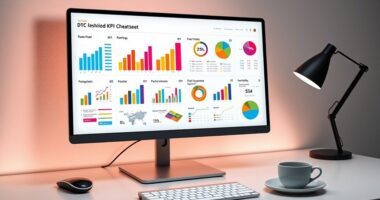

When forecasting demand with small data, focus on targeted analytics and segmentation to uncover meaningful insights. Use predictive models tailored to your specific data, such as seasonal trends or customer behavior, to improve accuracy. Prioritize data quality over quantity, analyzing relevant purchase patterns and identifying outliers. By applying these techniques, you can turn limited data into powerful, actionable forecasts. Keep exploring to discover how to optimize small datasets for better demand planning.

Get your wardrobe favorites delivered free — and shop member deals
- Fast, free delivery on millions of items
- Access to Prime Big Deal Days deals on October 6–7
- Prime Video, Amazon Music and more included
Key Takeaways
- Leverage predictive analytics to identify hidden demand patterns in small datasets.
- Use data segmentation to create targeted insights for specific customer groups.
- Focus on data quality and relevance rather than volume for more accurate forecasts.
- Apply statistical and machine learning models tailored to limited data environments.
- Combine insights from small data with strategic decision-making for proactive inventory planning.

While many rely on large datasets for demand forecasting, small data can be just as effective when approached correctly. The key lies in leveraging techniques like predictive analytics and data segmentation to extract meaningful insights from limited information. Instead of feeling constrained by the size of your data, focus on how you can maximize its value through smart analysis. Predictive analytics enables you to identify patterns and trends that might not be immediately apparent, even with a smaller dataset. By applying statistical models and machine learning techniques tailored to your specific data, you can forecast demand with a surprising degree of accuracy. This approach allows you to anticipate customer needs, optimize inventory levels, and improve overall decision-making.
Data segmentation plays a crucial role in enhancing the power of small data sets. By dividing your data into meaningful groups based on relevant characteristics—such as customer demographics, purchase history, or geographic location—you create more targeted and actionable insights. Segmentation helps you understand distinct customer behaviors, preferences, and demand patterns within each group. This granular approach enables you to tailor your forecasting models to specific segments rather than relying on broad, generalized assumptions. As a result, you can identify niche trends and respond proactively, even when your dataset isn’t vast.
You don’t need massive amounts of data to generate reliable forecasts. Instead, focus on quality over quantity. Carefully curated small data, paired with effective analytical techniques, can reveal demand signals that larger datasets might overlook. For example, if you analyze purchase patterns within a specific segment, you might uncover seasonal spikes or emerging preferences that inform your inventory planning. Predictive analytics tools can help you model these patterns, providing forecasts that guide your operational decisions. Additionally, data segmentation can help you identify outliers or anomalies, giving you the opportunity to address potential issues before they escalate. Incorporating emotional support strategies can also enhance stakeholder confidence in your forecasting process, especially when dealing with uncertainties inherent in small datasets.
Ultimately, small data demand forecasting is about strategic insight rather than sheer volume. When you use predictive analytics combined with thoughtful data segmentation, you turn limited information into a powerful tool. This approach allows you to make proactive, data-driven decisions that improve efficiency, reduce waste, and better serve your customers. Even with a modest dataset, you can achieve accurate, actionable forecasts—if you focus on quality, relevance, and targeted analysis. Small data isn’t a barrier; it’s an opportunity to refine your approach and access valuable demand insights tailored to your specific context.
predictive analytics software for small datasets
As an affiliate, we earn on qualifying purchases.
As an affiliate, we earn on qualifying purchases.
Frequently Asked Questions
How Do Small Data Challenges Differ Across Industries?
You’ll find that industry-specific challenges in small data vary, like sparse sales data in retail or limited customer info in healthcare. These differences mean you need tailored data sparsity solutions—such as synthetic data or enhanced sampling—to improve demand forecasts. Understanding your industry’s unique issues helps you apply the right techniques, ensuring more accurate predictions despite limited data, and ultimately, better decision-making across sectors.
What Tools Are Best for Small Data Demand Forecasting?
You should consider using simple machine learning models like decision trees or linear regression, which work well with limited data. Data visualization tools help you identify patterns and anomalies, making forecasting more accurate. These tools are user-friendly and enable quick insights. By combining machine learning with effective data visualization, you can improve demand forecasting even with small datasets, ensuring better decision-making without needing extensive data.
How Can Small Data Improve Accuracy Over Large Datasets?
You might think large datasets are always better, but small data can actually boost accuracy if you focus on customer segmentation and feature selection. By honing in on relevant customer groups and selecting the most impactful features, you reduce noise and improve prediction precision. This targeted approach helps you understand demand patterns more clearly, making your forecasts more reliable even with limited data. Small data, when used effectively, can outperform larger, unfocused datasets.
What Are Common Pitfalls When Forecasting With Small Data?
When forecasting with small data, you risk data sparsity, which makes it hard to identify reliable patterns, and overfitting risks, where your model becomes too tailored to limited data. You might assume trends that don’t hold in reality or miss important variations. To avoid these pitfalls, you should focus on simplifying your models, using domain knowledge, and validating your results thoroughly before making decisions.
How to Validate Small Data Demand Forecasts Effectively?
You should focus on model validation by testing your demand forecasts against actual outcomes regularly to guarantee accuracy. Prioritize data quality by cleaning and verifying your small dataset to minimize errors. Use techniques like cross-validation and residual analysis to identify model weaknesses. Incorporate domain knowledge to interpret results, and update your model frequently as new data becomes available, ensuring your forecasts stay relevant and reliable despite limited data.
Conclusion
By embracing small data, you open unique, understated insights that drive smarter strategies. Don’t dismiss the power of precise, personal predictions—small data can profoundly shape your success. With careful collection, clever calibration, and consistent calibration, you can confidently forecast demand and confidently carve out your corner of the market. Remember, with small data, your detailed, deliberate decisions deliver dynamic, dependable results, proving that sometimes, less truly leads to lasting, lucrative impact.
Fall Picks
fall essentials
As an affiliate, we earn on qualifying purchases.