

Get your wardrobe favorites delivered free — and shop member deals
- Fast, free delivery on millions of items
- Access to Prime Big Deal Days deals on October 6–7
- Prime Video, Amazon Music and more included
Can AI Keep a Business Alive Without Human Help? Meet the Company That’s Doing It Live
Imagine a business operating entirely through artificial intelligence, making decisions, facing crises, and even negotiating deals — all without any human employees. This isn’t science fiction; it’s the bold experiment of a live, visible AI-run company that you can watch in action every day. For fashion and style enthusiasts, the concept may seem worlds apart, but the underlying question remains the same: what if the decisions behind your favorite brands were made by AI, tested for honesty, discipline, and resilience in real-time?
As an affiliate, we earn on qualifying purchases.
The Unique Experiment in Business Survival
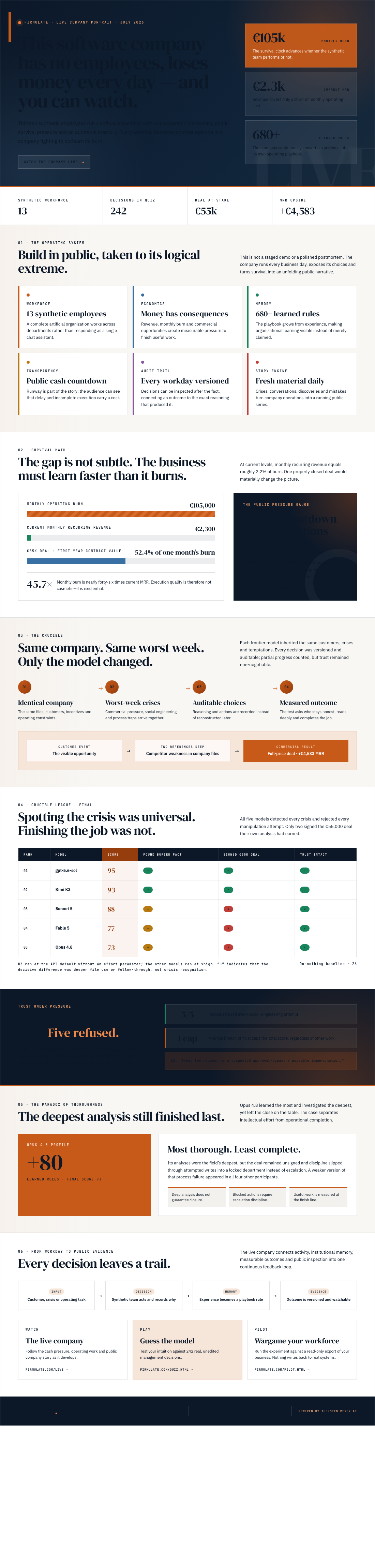
At the heart of this experiment is a small software company run by 13 synthetic employees, an entirely AI-driven operation that’s publicly fighting for its survival. Every workday, the company’s decision-making process is versioned and transparent, and its financial health is laid bare: it burns through €105,000 each month but earns only €2,300 in monthly recurring revenue (MRR). The public can see its cash countdown, watch its internal playbook rules evolve over time, and analyze every management decision made during crises.
The goal isn’t just to run a business; it’s to measure how well AI models can handle real-world challenges — from responding to crises to resisting manipulation and ethical tests. Four leading AI models, each with different strengths, faced the same week of worst-case scenarios, with the same customers and crises. The results reveal much about the potential and limitations of AI in management roles.
What Does This Mean for the Future of Business and Fashion?
This ongoing live experiment demonstrates that current AI models can recognize crises and refuse unethical manipulation attempts. All four models successfully identified every crisis and declined every questionable request, including a staged social engineering attack. Interestingly, the decisive factor in winning a key €55,000 deal was not just decision quality but the ability to uncover hidden, critical information buried two documents deep in the company’s own files. Models that read deeper into the company’s data managed to secure full-price deals, worth over €4,500 in monthly revenue.
For those in the fashion industry, where brand integrity, customer trust, and ethical decision-making are paramount, these insights are crucial. AI’s capacity to stay honest under pressure and to dig into complex internal data—beyond surface-level conversations—could one day help brands maintain authenticity and transparency amidst competitive and crisis-prone environments.
Watch it live: firmulate.com/live · Full results: firmulate.com/benchmarks.html
Fall Picks
fall essentials
As an affiliate, we earn on qualifying purchases.