

Shopping for deals on Amazon can mean very different things depending on what you want to improve. I narrowed this comparison to two Amazon devices with distinct jobs: the Fire HD 10 tablet for portable entertainment and family use, and the Fire TV Stick 4K Plus for upgrading a compatible television. The tablet is the more flexible pick, with its own screen, expandable storage, and up to 13 hours of stated battery life. The streaming stick is the more focused choice, adding 4K, Dolby Vision, HDR10+, and Wi-Fi 6 to a TV that supports them.

Get your wardrobe favorites delivered free with Prime
- Fast, free delivery on millions of items
- Prime Video, Amazon Music and more included
- Member-only deals all year
My ranking reflects usefulness across different everyday needs, not a claim that one device suits every shopper. I put the tablet first because it works on its own for reading, streaming, and light gaming; the Fire TV Stick makes more sense if your priority is a home theater setup. Neither is a universal bargain: the tablet’s 32 GB of built-in storage may call for a microSD card, while the stick’s headline picture formats depend on a compatible TV and streaming service. I compare those tradeoffs below so you can choose the device that fits the screens and habits you already have.
Key Takeaways
- Choose the Fire HD 10 if you want a self-contained screen for streaming, reading, and family use; it is the more versatile pick in this pair.
- Choose the Fire TV Stick 4K Plus if you already own a compatible 4K television and want Dolby Vision, HDR10+, and Wi-Fi 6 streaming.
- The tablet lists 32 GB of storage with microSD expansion up to 1 TB; the stick has 8 GB, so neither has generous built-in room for every use.
- The Fire HD 10’s up to 13-hour battery claim supports portable sessions, while the TV stick is designed to stay connected to a television.
- The Fire TV Stick’s 4K and HDR advantages only matter when the TV, streaming app, and content support those formats.
| Amazon Fire HD 10 Tablet, 10.1-inch Full HD Display, Octa-core Processor, 4 GB RAM, 32 GB, Black | 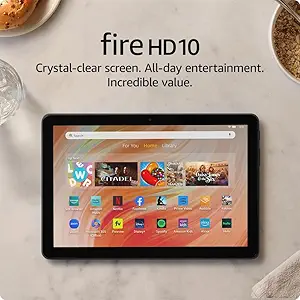 | Best Overall: the flexible screen for everyday use | Display: 10.1-inch Full HD | Processor: Octa-core | RAM: 4 GB | VIEW ON AMAZON | See Our Full Breakdown |
| Fire TV Stick 4K Plus (2026 Model) with Alexa+ and Wi-Fi 6 |  | Best for 4K TV owners: a focused streaming upgrade | Processor: Quad-core 1.7 GHz | GPU: 650 MHz | Storage: 8 GB | VIEW ON AMAZON | See Our Full Breakdown |
| deals on amazon | Processor | Storage | Display | RAM |
|---|---|---|---|---|
| Amazon Fire HD 10 Tablet | Octa-core | 32 GB | 10.1-inch Full HD | 4 GB |
| Fire TV Stick 4K Plus | Quad-core 1.7 GHz | 8 GB | — | — |
More Details on Our Top Picks
Amazon Fire HD 10 Tablet, 10.1-inch Full HD Display, Octa-core Processor, 4 GB RAM, 32 GB, Black
I rank the Fire HD 10 as the best overall pick because it can serve several roles without needing another display: it has a 10.1-inch Full HD screen for video, reading, and casual games, plus a stated battery life of up to 13 hours for use away from a power outlet. Its octa-core processor and 4 GB RAM describe a general-purpose entertainment tablet, not a laptop replacement. For shoppers browsing deals on Amazon who want one device for the household, its parental controls and Amazon Kids+ support give it a family angle that the TV stick does not offer.
Compared with the Fire TV Stick 4K Plus, the tablet is more self-contained: it has a screen, cameras, and battery, so it travels between rooms or on a trip. The stick is the better fit for a fixed television and adds 4K formats and Wi-Fi 6, which the tablet’s supplied specs do not claim. That makes this a choice between portable flexibility and a focused TV upgrade, rather than two direct substitutes.
The main compromise is 32 GB of built-in storage. Expandable capacity up to 1 TB via microSD can help, but buyers who keep many downloads should plan around that slot; extra storage does not erase the initial limit. A stylus is sold separately, and some features require additional purchases. I would skip this tablet if you need a work-oriented computer, high-end gaming, or a stylus included in the box. For streaming, reading, and supervised family use, it covers more situations than the stick.
Pros:- 10.1-inch Full HD display gives video and reading a larger viewing area than a phone.
- Up to 13 hours of stated battery life suits extended sessions away from a charger.
- Expandable storage up to 1 TB provides a way to add room for media and downloads.
- Parental controls and Amazon Kids+ make it more family-focused than the Fire TV Stick.
Cons:- 32 GB of built-in storage can feel restrictive without a microSD card.
- The stylus is sold separately, and some features require additional purchases.
- It does not provide the listed 4K, Dolby Vision, or Wi-Fi 6 feature set of the TV stick.
Best for: Households and casual users who want a portable screen for video, reading, light gaming, and parental-control features.
Not ideal for: Buyers who need a laptop replacement, demanding gaming performance, ample built-in storage, or a stylus included.
- Display:10.1-inch Full HD
- Processor:Octa-core
- RAM:4 GB
- Storage:32 GB
- Expandable storage:Up to 1 TB microSD
- Battery life:Up to 13 hours
- Camera:5 MP front-facing
Our verdict“I recommend the Fire HD 10 for shoppers who want the broadest everyday utility from this pair and can live with limited base storage.”
Fire TV Stick 4K Plus (2026 Model) with Alexa+ and Wi-Fi 6
The Fire TV Stick 4K Plus is the more targeted choice: it plugs into a television’s HDMI connection and is built to stream rather than act as a general-purpose screen. It supports 2160p output and lists Dolby Vision, HDR10+, HLG, and Dolby Atmos among its formats. For someone with a compatible 4K TV and services that carry matching content, that combination can make this a more relevant Amazon deal than buying a second portable screen.
Its Wi-Fi 6 support is a useful distinction from the Fire HD 10’s supplied spec list. It can suit a home where several devices share a wireless network, though actual streaming still depends on network conditions, the router, and the service. The Alexa Voice Remote with IR control offers a direct way to navigate shows and control compatible equipment. The stick also lists HDMI 2.1 with ARC and broad video codec support, but buyers should check the capabilities of their TV and sound setup before expecting every format to work.
Compared with the Fire HD 10**, this model cannot go with you as a screen for reading or travel; it needs a connected television and power. It is a better match for a living room that already has the right display, and a poor fit if your television is only HD or if the apps you use do not stream in 4K or HDR. Its 8 GB storage is limited, too. I’d choose the tablet for flexibility, but this stick for a dedicated TV upgrade where its format support can actually be used.
Pros:- Supports 4K Ultra HD, Dolby Vision, and HDR10+ on compatible equipment and content.
- Wi-Fi 6 can help it fit into a busy home network with multiple connected devices.
- Alexa Voice Remote includes IR control for navigation and compatible device control.
- Dolby Atmos and HDMI pass-through support add options for compatible audio setups.
Cons:- A compatible 4K TV and supported streaming content are needed to use its main picture features.
- Its 8 GB internal storage is limited.
- Unlike the tablet, it cannot provide a screen or entertainment away from a television.
Best for: Owners of a compatible 4K television who want a dedicated streaming device with Wi-Fi 6, HDR formats, and Alexa voice control.
Not ideal for: People without a 4K television, buyers seeking a portable screen, or viewers whose services and content do not support 4K or HDR.
- Processor:Quad-core 1.7 GHz
- GPU:650 MHz
- Storage:8 GB
- Wi-Fi:Wi-Fi 6 dual-band
- Bluetooth:5.2 + BLE
- Remote:Alexa Voice Remote with IR control
- Video formats:Dolby Vision, HDR10+, HLG, H.265, H.264, VP9, AV1
- Supported resolutions:2160p, 1080p, and 720p up to 60 fps
Our verdict“I recommend the Fire TV Stick 4K Plus when a compatible 4K television is already in place and streaming quality matters more than portability.”

How We Picked
I selected these two products because they answer different common Amazon-device shopping questions: whether to add a portable screen or improve streaming on a television. I ranked the Fire HD 10 first for breadth of use, since its display and battery make it usable away from a TV, and I ranked the Fire TV Stick 4K Plus for a specific home setup that can take advantage of its picture and audio formats.
For each device, I focused on the supplied specifications and the practical consequences they suggest: screen resolution, stated battery life, expandable storage, network support, compatibility requirements, and included control options. I also accounted for stated limitations, including the tablet’s modest base storage and separately sold stylus, and the stick’s reliance on a compatible 4K television and service for its strongest video features. Because this is a roundup framed around Amazon deals, I treat value as a matter of how much useful capability fits a buyer’s needs, not a promise about changing offers. I do not use price or customer ratings to make the ranking.
| deals on amazon | Processor |
|---|---|
| Amazon Fire HD 10 Tablet | Octa-core |
| Fire TV Stick 4K Plus | Quad-core 1.7 GHz |
Factors to Consider When Choosing Deals On Amazon
I’d start by deciding where you want the upgrade to happen: in your hands or on your television. That single question separates these two Amazon device deals more clearly than their shared entertainment focus.Choose the screen you will use most
The Fire HD 10 brings its own 10.1-inch display, making it useful in a kitchen, bedroom, or during travel. It can replace phone-sized viewing for reading and video, though it remains a tablet built around entertainment and everyday tasks. The Fire TV Stick assumes you already have a screen: it adds streaming functions to a compatible TV but cannot follow you from room to room as a standalone device. If you are shopping for a device that serves multiple members of a household in different places, the tablet is the more flexible choice. If the living room is the only target, the stick has the clearer purpose.
Check whether 4K and HDR will work in your setup
The stick’s 4K, Dolby Vision, and HDR10+ support are meaningful only when your television, streaming app, subscription or content, and playback settings support the same formats. A 4K-capable stick connected to an HD television will not create a 4K picture. The Fire HD 10’s Full HD screen serves a different role: it gives you a detailed portable viewing surface, but it is not the way to improve a television’s picture. Before choosing the stick, check your TV model and the services you actually watch. If those checks do not line up, its headline video formats may not influence your day-to-day experience.
Plan around storage and downloads
Built-in capacity is modest on both devices, though the tablet offers an expansion route. The Fire HD 10 starts with 32 GB and supports microSD cards up to 1 TB, useful if you want more room for offline media or other files. The TV stick lists 8 GB, so it is better treated as a streaming hub than a place to keep a large personal library. Neither supplied specification guarantees how much space will be available after software and apps. If you often download episodes, maps, or large games, account for that habit before deciding; if you mainly stream over a reliable connection, storage may matter less.
Match the device to your household and network
The tablet includes parental controls and Amazon Kids+ in its family-oriented feature set, while the stick emphasizes television control through an Alexa Voice Remote and smart-home integration. Wi-Fi 6 on the stick is a useful network compatibility feature, but it does not guarantee smooth playback if the broadband connection is weak or the router is poorly placed. Consider who will use the device and where: a child who needs a supervised personal screen points toward the tablet, while a household that shares a TV and wants voice navigation points toward the stick. Their convenience depends on the home setup, not just the spec sheet.
Judge the deal by useful features, not a headline
Amazon offers can change, so I would compare the current listing and included accessories when you shop rather than assume either product is always the better deal. Count the capabilities you will actually use: a microSD card may be useful for the tablet, while a compatible 4K display is a prerequisite for the stick’s strongest picture features. The tablet’s stylus is separate, and some features on either device may involve additional purchases or services. A listing can look compelling while including less than you expect, so check the exact model, included remote or accessories, and compatibility notes before placing an order.
Frequently Asked Questions
Which of these Amazon devices is the better all-around choice?
I’d choose the Fire HD 10 for broader everyday use because it has its own screen and battery, so it can support reading, streaming, and casual games in several places. The Fire TV Stick is the more capable option for a narrower task: streaming to a compatible television with 4K and HDR support. If you need a device that works independently of a TV, the tablet is the straightforward pick.
Do I need a 4K television for the Fire TV Stick 4K Plus?
You do not need a 4K television for the stick to connect and stream, but you do need a compatible 4K TV to see 4K output. Dolby Vision and HDR10+ also depend on the TV and the content or service supporting those formats. With an HD television, the stick can still be useful for streaming, but its highest resolution and HDR features will not be available in full.
Can I expand storage on either device?
The Fire HD 10 supports microSD expansion up to 1 TB, according to its supplied specifications. The Fire TV Stick 4K Plus lists 8 GB of internal storage and no expansion option in the product details provided here. If you expect to keep downloaded media or a larger collection of apps, the tablet offers more room to grow, though its 32 GB of built-in space is still limited on its own.
Which device is a better fit for family use?
The Fire HD 10 is the stronger family fit when a child or family member needs a personal screen, since its listed features include parental controls and Amazon Kids+. The TV stick works better for shared viewing in a living room, with a voice remote and access to streaming apps. Choose based on whether the household needs supervised individual use or a more convenient way to navigate a television.
Will every streaming service play in 4K or HDR on the Fire TV Stick?
No. The Fire TV Stick supports several 4K and HDR formats, but the service, specific title, account or plan, and connected television must also support the format. Some shows may stream in HD even when the hardware can handle 4K. Check the content and equipment you already use if picture format support is a main reason for choosing the stick.
Conclusion
I’d pick the Fire HD 10 for readers, families, and casual viewers who want one portable screen for several everyday activities and can manage its base storage with a microSD card if needed. The Fire TV Stick 4K Plus is the better match for 4K TV owners who want a dedicated streaming upgrade and can use its HDR formats. If you are comparing deals on Amazon, weigh those real fit differences against the exact listing and accessories: the tablet wins on versatility, while the stick earns its place through television-focused streaming features.
Fall Picks
fall essentials
As an affiliate, we earn on qualifying purchases.