
Lab-grown diamonds and moissanite differ in composition and optical properties that affect their sparkle. Diamonds have a refractive index of about 2.42, while moissanite’s is higher at around 2.65, causing moissanite to produce more fire and colorful flashes. Moissanite’s high dispersion enhances its sparkle, especially in bright settings. If you want to understand how these scientific factors influence their appearance and value, explore further details ahead.
Listen free for 30 days with Audible
Thousands of audiobooks and originals — cancel anytime.
As an affiliate, we earn on qualifying purchases.
Key Takeaways
- Moissanite has a higher refractive index (~2.65) than lab-grown diamonds (~2.42), resulting in more vibrant sparkle and fire.
- Moissanite’s high dispersion produces intense rainbow flashes, making its fire more vivid than that of lab-grown diamonds.
- Lab-grown diamonds offer brilliance and clarity similar to natural diamonds, with their optical properties optimized for subtle sparkle.
- Moissanite’s optical and thermal properties amplify its fiery sparkle, creating a more eye-catching, colorful display in various lighting conditions.
- Both gemstones’ sparkle is influenced by cut and setting, but moissanite’s higher dispersion generally makes it appear more dazzling.
Top picks for "grown diamond moissanite"
As an affiliate, we earn on qualifying purchases.
What Are Lab-Grown Diamonds and Moissanite Made Of?
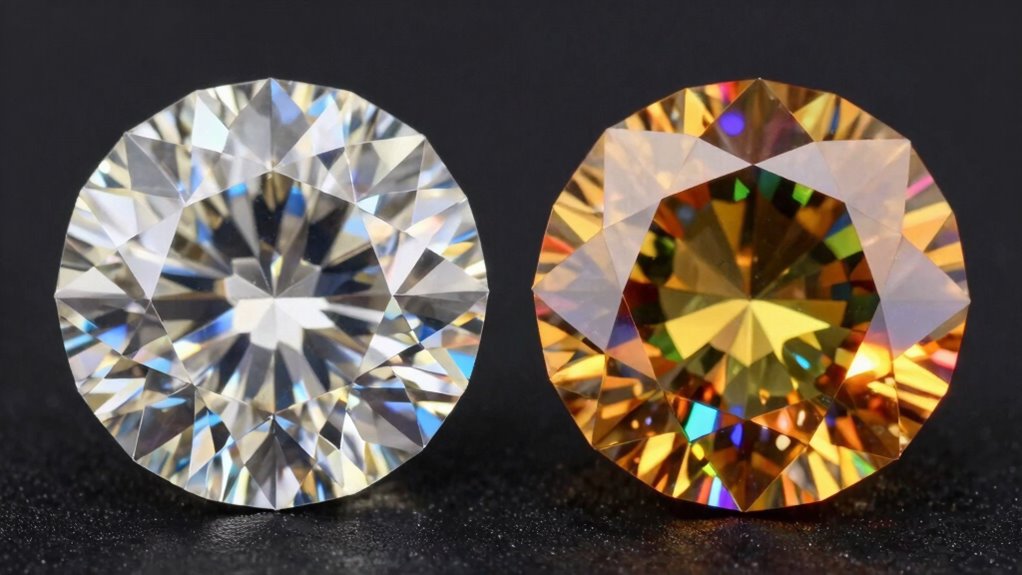
Lab-grown diamonds and moissanite are made from different materials, each with distinct compositions. You’ll find that lab-grown diamonds have the same chemical composition as natural diamonds, composed of carbon atoms arranged in a crystal lattice. Their formation process involves high-pressure, high-temperature (HPHT) or chemical vapor deposition (CVD) methods, mimicking natural conditions deep within the Earth. This process is related to Free Floating mineral formation in natural environments. The crystal structure of lab-grown diamonds closely resembles that of natural diamonds, which contributes to their similar optical properties. Additionally, the formation environment influences their internal qualities and clarity. The growth process of lab-grown diamonds can be precisely controlled to optimize clarity and color, which is a significant advantage over natural stones. Moissanite, on the other hand, is made from silicon carbide crystals. Its formation process occurs synthetically in laboratories through processes like the arc furnace method, where silicon and carbon are fused under intense heat. This difference in chemical composition and formation process results in unique characteristics for each gemstone, affecting how they look, feel, and respond to light.
How Do Refractive Index and Dispersion Create Sparkle in These Gems?
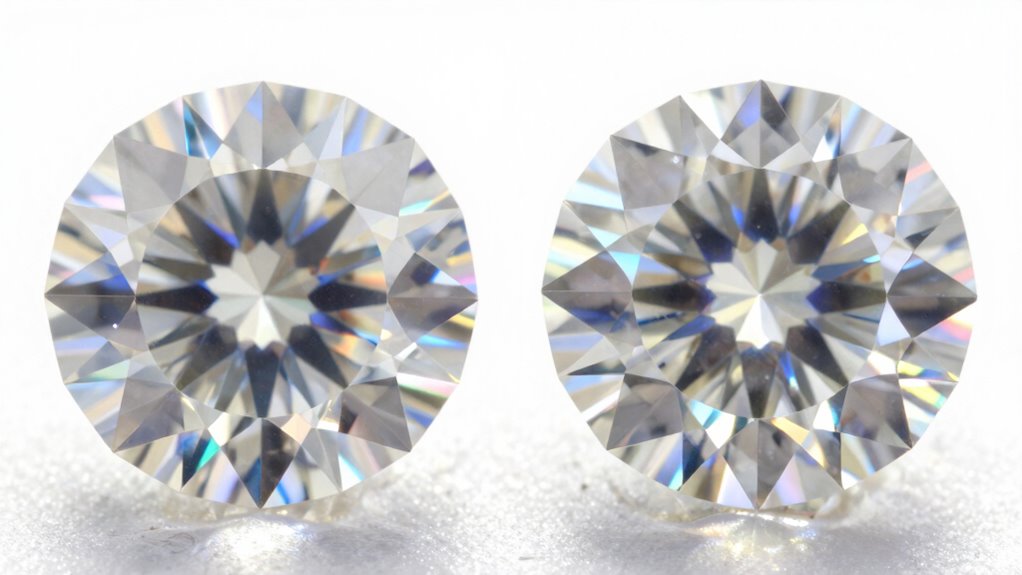
Refractive index and dispersion are key factors that determine how much a gemstone sparkles. A high refractive index means light bends more inside the gem, creating more brilliance. Dispersion spreads the light into spectral colors, enhancing sparkle. For instance, moissanite’s high refractive index (about 2.65) and dispersion give it exceptional fire. Lab-grown diamonds also have a high refractive index (~2.42), but dispersion is slightly lower. Gemstone treatments can influence these properties, sometimes color-enhancing treatments affect how light interacts with the gem.
| Gemstone | Refractive Index | Dispersion |
|---|---|---|
| Lab-Grown Diamond | ~2.42 | Moderate |
| Moissanite | ~2.65 | Very high |
| Color Enhancement | Varies | Can alter sparkle |
| Gemstone Treatments | May impact optical properties |
What Role Do Cut and Clarity Play in Enhancing Sparkle?

The precision of a cut determines how well a gem reflects light and creates sparkle. Clarity affects how unobstructed your gem’s internal reflections are, boosting its brilliance. When cut and clarity align, you’ll notice a significant increase in the gem’s overall sparkle and allure. Additionally, understanding how craftsmanship and traditional techniques influence gem quality can help you appreciate the artistry behind each stone.
Precision of Cut
When it comes to enhancing a diamond’s sparkle, the precision of its cut plays a crucial role. Good cut precision ensures that each facet is perfectly aligned, maximizing light reflection and brilliance. Misaligned facets can cause light to escape rather than bounce within the stone, dulling its sparkle. Focus on facet alignment, as it directly impacts how well the diamond interacts with light. A precisely cut diamond will have symmetrical facets that direct light to its apex, creating that iconic fire and scintillation. Whether you’re choosing a lab-grown diamond or moissanite, pay close attention to the cut quality. The better the facet alignment and overall cut precision, the more stunning and lively your gemstone will appear. cut quality also influences how effectively a gemstone displays its inherent optical properties, making it a key factor in selecting a stone that truly sparkles.
Clarity and Light Reflection
A gemstone’s clarity considerably influences how much light it can reflect and transmit, directly affecting its sparkle. When clarity is high, fewer internal flaws or inclusions scatter light, allowing more to pass through and enhance brilliance. When inclusions are present, they can create internal shadows and reduce the gemstone’s overall luminosity. The chemical composition of lab-grown diamonds and moissanite impacts their clarity; diamonds, with their pure carbon structure, typically have fewer inclusions, while moissanite’s silicon carbide makeup can contain more. Clarity affects light behavior by determining how effectively light enters, bounces within, and exits the stone. A clearer gemstone allows for optimal light reflection, creating a dazzling sparkle. Additionally, stone clarity plays a crucial role in the overall light performance and visual appeal of the gemstone. The cut quality also significantly influences how well the gemstone interacts with light, further enhancing its brilliance. Proper cut proportions ensure that light is optimally reflected internally and externally, maximizing sparkle. Conversely, inclusions or cloudiness hinder light’s path, dulling the gem’s brilliance. Consequently, clarity and cut together play pivotal roles in maximizing a gemstone’s light performance and overall sparkle.
Why Does Moissanite Often Show More Fire Than Diamonds?
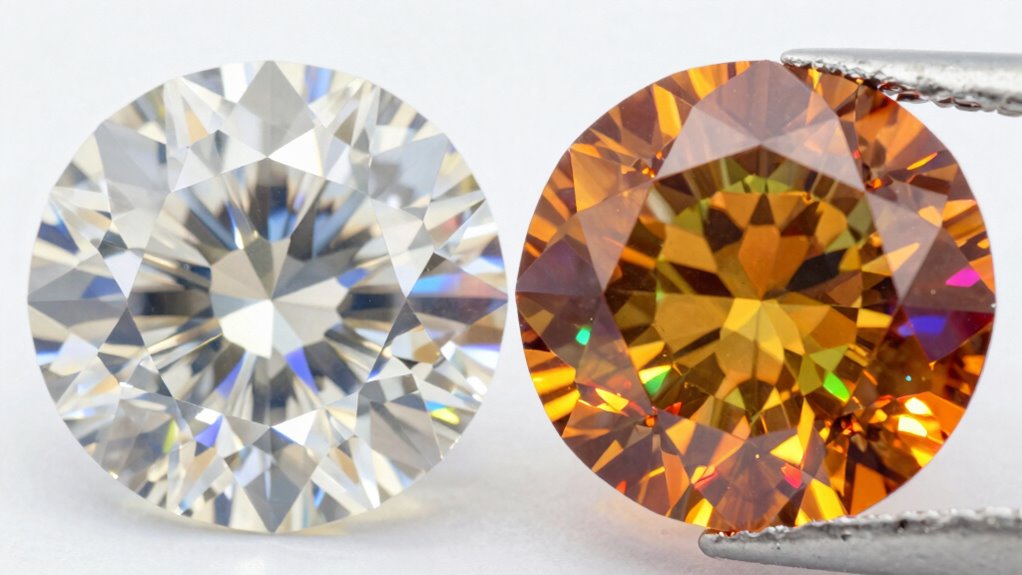
Moissanite often displays more fire than diamonds because of its unique optical properties. Its high dispersion causes it to split light into a vivid spectrum of colors, creating more colorful flashes known as fire. This effect is enhanced by its strong color contrast, making the rainbow-like sparkle more noticeable. Additionally, moissanite’s thermal conductivity differs notably from that of diamonds. While diamonds conduct heat efficiently, moissanite’s lower thermal conductivity causes light to bend and reflect differently within the stone, amplifying its fiery appearance. These factors combined mean that, under light, moissanite produces more colorful flashes and a lively sparkle that many find more eye-catching. The result is a gem that often outshines diamonds in fire, thanks to these distinct optical and thermal characteristics. Furthermore, the spectral dispersion of moissanite is higher than that of diamonds, contributing significantly to its vibrant fire display.
Which Gem Looks Brighter and More Radiant in Different Settings?
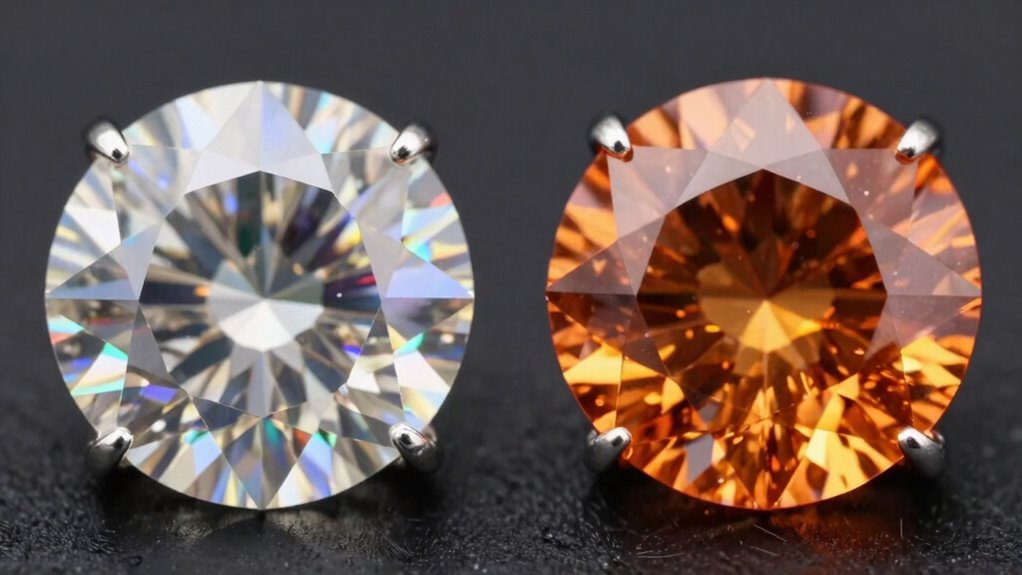
The brightness and radiance of a gem can vary substantially depending on the setting and lighting conditions. Lab-grown diamonds generally appear brighter in settings with high color contrast because their clear, colorless nature reflects light efficiently. Moissanite, with its higher thermal conductivity, disperses light more effectively, creating a fiery sparkle that stands out in many environments. In settings with subdued lighting, diamonds may seem more radiant due to their superior brilliance and clarity, while moissanite’s fire and sparkle can be more noticeable in bright, direct light. Your choice depends on the look you prefer; diamonds offer a classic, subtle glow, whereas moissanite provides a vibrant, fiery display that catches the eye. Both gems can look stunning, depending on how they’re set and lit. Understanding light dispersion can help you decide which gem better suits your preferred aesthetic, especially when considering the optical properties that influence their sparkle. Additionally, light behavior plays a crucial role in how each gemstone interacts with its surroundings and enhances its overall brilliance, which can be further appreciated by examining their refractive indices.
Is Moissanite a Better Value for Sparkle and Fire?

While both lab-grown diamonds and moissanite can deliver stunning visual effects, many consider moissanite to offer a better value when it comes to sparkle and fire. Moissanite, a popular synthetic gemstone, exhibits a brilliance that rivals diamonds, often appearing more vibrant due to its higher dispersion of light. Because of its synthetic nature, moissanite is typically less expensive, providing excellent fire at a fraction of the cost. Unlike some gemstone treatments used to enhance diamonds, moissanite’s appearance is consistent without requiring additional treatments. This makes it a practical choice for those seeking maximum sparkle without the premium price tag. Additionally, moissanite’s reliable quality and consistency make it an attractive option for value-conscious buyers. Its environmental impact is also lower compared to mined diamonds, appealing to eco-conscious consumers. Furthermore, advances in production technology ensure that moissanite maintains its long-lasting durability, making it suitable for everyday wear. In fact, new manufacturing methods continue to improve its overall quality and brilliance. Overall, moissanite’s combination of vibrant fire and affordability makes it a compelling choice for value-conscious buyers.
How to Decide Between Lab-Grown Diamonds and Moissanite Based on Science and Style?

Deciding between lab-grown diamonds and moissanite hinges on understanding both their scientific properties and your personal style preferences. Conduct synthetic gemstone comparisons to see how each stone’s brilliance, fire, and durability align with your desired look. If you prefer classic, luxurious styles, lab-grown diamonds offer a more authentic appearance with high clarity and color. For bolder, more affordable stylistic jewelry choices, moissanite provides exceptional sparkle and a vibrant hue that stands out. Consider how each gemstone’s unique optical properties fit your aesthetic. Your decision should balance science—such as hardness and fire—and your style goals. Ultimately, understanding these factors helps you select the gemstone that matches your taste while meeting your expectations for quality and visual impact.
Tips to Choose the Most Sparkling Gem for Your Budget?

When choosing a sparkling gem within your budget, consider options that offer the best balance of brilliance and value. Think about how durability and appearance influence your decision, ensuring the stone lasts and looks stunning over time. Additionally, understanding modern gemstone technology can help you identify quality enhancements that enhance brilliance without significantly increasing cost. For example, innovations like vetted—Serat Nest treatments can improve the visual appeal and durability of lab-grown diamonds and moissanite alike. These advancements utilize cutting-edge techniques that optimize light reflection, further elevating the gem’s sparkle and longevity. Being aware of technological enhancements can also guide you in selecting stones that have improved visual qualities without added expense. Recognizing industry advancements can help you make more informed choices, ensuring you select a gem that offers impressive sparkle without overspending.
Budget-Friendly Sparkle Options
If you’re searching for a dazzling gem that fits your budget, you’ll want to contemplate both lab-grown diamonds and moissanite. When comparing these options, consider color grading—moissanite often has a slightly warmer hue, while lab-grown diamonds can be clearer and more colorless. If you prioritize ethical sourcing, lab-grown diamonds are typically more transparent about their origin, as they’re produced in controlled environments. Moissanite, on the other hand, is usually lab-created as well, but it can sometimes be less expensive due to its lower production costs. Both options provide excellent sparkle without breaking the bank, but your choice depends on your preferences for clarity, color, and ethical considerations. By understanding these factors, you can select the most budget-friendly gem that still offers brilliant sparkle. Additionally, understanding the quality of sparkle can help you make a more informed decision.
Being aware of sparkle quality factors can guide you toward choosing a gem that maximizes brilliance within your budget.
Durability and Appearance Factors
Choosing the right gem isn’t just about sparkle and price — it’s also about durability and how it will hold up over time. When comparing lab-grown diamonds and moissanite, consider their durability factors. Diamonds score a 10 on the Mohs scale, making them incredibly resistant to scratches. Moissanite, with a rating of 9.25, is also durable but slightly softer. Look at color grading; diamonds often have a wider range, so a higher grade means fewer visible color nuances. Surface flaws can affect appearance and longevity; diamonds typically have fewer flaws, enhancing durability. Moissanite may show tiny inclusions or surface blemishes more readily, impacting its appearance over time. Choose based on how well the gem maintains its brilliance and resilience for your lifestyle.
Frequently Asked Questions
How Does the Durability of Lab-Grown Diamonds Compare to Moissanite?
You’ll find that lab-grown diamonds are more durable than moissanite because of their higher diamond hardness, making them extremely resistant to scratches and chips. This gemstone resilience guarantees your jewelry stays pristine longer. Moissanite, while still durable, is less hard and more prone to scratches over time. If durability is your priority, lab-grown diamonds offer superior protection against daily wear and tear, keeping your piece looking stunning.
Are There Any Environmental Impacts Associated With Creating These Gems?
Yes, creating lab-grown diamonds and moissanite has environmental impacts. You should consider the environmental footprint involved, such as energy consumption and emissions, since high-tech processes require substantial electricity. However, they generally have a smaller impact on resource sustainability compared to mined gems. Opting for lab-grown options helps reduce habitat destruction and raw material extraction, making them a more eco-conscious choice for environmentally aware consumers.
Can Lab-Grown Diamonds and Moissanite Be Distinguished With the Naked Eye?
You can usually tell lab-grown diamonds from moissanite with the naked eye, but it’s tricky—like spotting a needle in a haystack. Visual differences include moissanite’s fiery sparkle and slight color distinctions, often appearing more yellow or greenish compared to diamonds’ brilliance. Under magnification, subtle clues emerge, but to the untrained eye, they look remarkably alike, making professional testing your best bet for certainty.
What Are the Best Settings to Maximize Sparkle for Each Gemstone?
To maximize sparkle, choose prong settings for both lab-grown diamonds and moissanite, as they allow maximum light entry and reflection. For a sleek look, bezel settings can also enhance brilliance by securely framing the stones while still showcasing their sparkle. Make certain your gemstone is well-centered and the setting’s design complements its facets. Properly chosen settings boost their natural brilliance, making your jewelry truly stand out.
How Do Certification and Grading Affect the Perceived Value of These Gems?
Certification and grading directly influence how you perceive the value of these gems. They enhance trust, establish transparency, and support your confidence in quality. For lab-grown diamonds, certification boosts market reputation and collector appeal by confirming authenticity and cut quality. Moissanite’s grading assures you of its brilliance and durability, making it easier to compare and choose. Ultimately, proper grading elevates your confidence, ensuring you select a gemstone that meets your expectations and desires.
Conclusion
Ultimately, choosing between lab-grown diamonds and moissanite boils down to what sparkles most for you. Think of it as a dance of science and style—each gem with its own rhythm. Whether you crave the timeless brilliance of a diamond or the fiery sparkle of moissanite, your perfect gem awaits. Trust your eyes, feel the thrill, and let your heart guide you—because in the end, it’s your sparkle story that truly matters.
Fall Picks
fall essentials
As an affiliate, we earn on qualifying purchases.