
TL;DR

Get your wardrobe favorites delivered free with Prime
- Fast, free delivery on millions of items
- Prime Video, Amazon Music and more included
- Member-only deals all year
Building an AI workstation used to be cheaper, but in 2026, prebuilt systems often match or beat DIY costs thanks to component shortages and bulk buying. The real decision now revolves around support, customization, and how much effort you’re willing to put in.
Imagine you’re ready to jump into AI development. You’ve got the workload, but the question hits: should you build your own machine or just buy one ready-made? That choice used to be a no-brainer—building was always cheaper. But in 2026, the game has shifted. The rising costs of GPUs, RAM, and SSDs have made DIY more expensive than many realize. Meanwhile, high-end prebuilt systems offer a tempting mix of convenience, support, and even cost savings. So, which path makes sense for you? Let’s break down the facts and help you decide.
Whether you’re a hobbyist, a startup, or a researcher, understanding the real tradeoffs can save you time, money, and headaches. This isn’t just about price—it’s about control, reliability, and how fast you can get your AI projects off the ground. Ready to compare the build and buy options with fresh eyes? Let’s dive in.
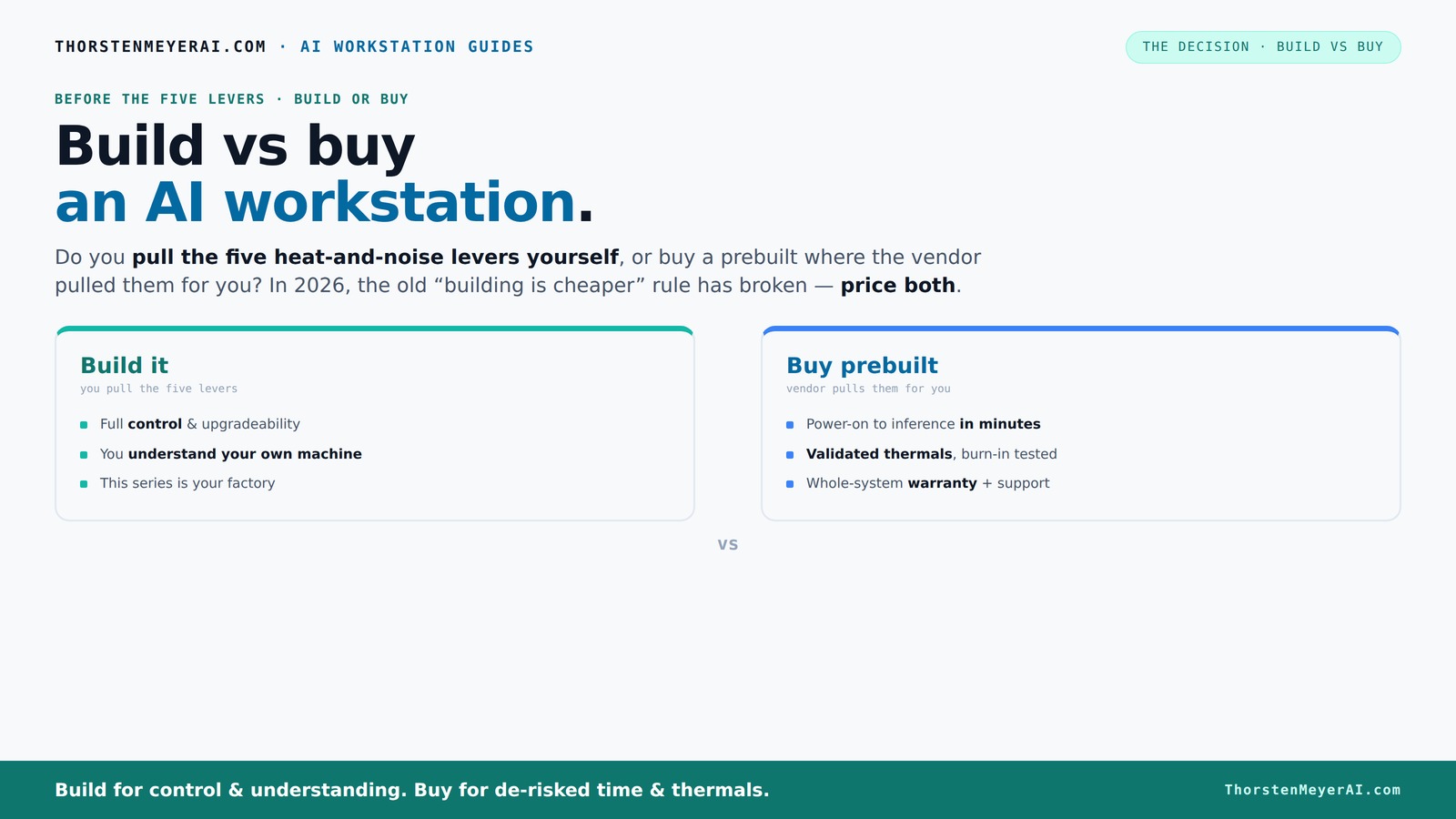
Build vs buy
an AI workstation.
The real question behind this whole series: do you pull the five heat-and-noise levers yourself, or buy a prebuilt where the vendor pulled them for you? And in 2026, the old “building is cheaper” rule has broken. Match your situation in Part 3.
Key Takeaways
- In 2026, prebuilt AI workstations often match or beat DIY costs due to component shortages and bulk discounts.
- Choosing between build and buy hinges on thermal management, support needs, and upgrade plans—not just price.
- Vendors validate thermals, run stress tests, and offer warranties, making prebuilt systems a lower-risk option for heavy workloads.
- DIY builds offer unmatched customization and upgradeability but demand time, skill, and troubleshooting effort.
- Decide based on your workload urgency, support tolerance, and whether you prefer plug-and-play or hands-on tuning.
As an affiliate, we earn on qualifying purchases.
Why 2026 Changes the Build-vs-Buy Playbook for AI Workstations
In 2026, building your own AI workstation is no longer automatically cheaper. The reason? Component shortages and bulk purchasing power have driven up prices for key parts like GPUs, DDR5 RAM, and SSDs—sometimes by as much as 30% compared to previous years. A system that once cost under $1,000 now easily hits $1,250 or more, even before adding an OS or support.
Meanwhile, major prebuilt vendors like Lambda or Puget Systems buy components in large quantities, locking in lower prices. They also validate thermals, run long stress tests, and optimize for noise and heat—costs that you’d have to pay out of pocket if you build yourself. This validation process is crucial because it ensures reliability under heavy workloads, reducing the risk of hardware failures or thermal throttling that can derail projects. Learn more about building vs buying AI workstations. The old rule—build for the savings—is broken. Today, a careful price comparison is the first step in any decision. For more insights, visit Build vs Buy a Prebuilt AI Workstation.
This shift turns the typical DIY versus prebuilt debate into a nuanced choice. It’s less about price and more about time, risk, and control. Building a system yourself might save money initially, but when factoring in the time spent sourcing parts, troubleshooting, and testing, the total cost can tilt in favor of prebuilt options. Conversely, if you value maximum customization or have specific hardware needs, DIY may still be justified. Keep reading to see how these factors impact your decision.
The Five Levers of a High-Power AI Workstation — Who Pulls Them?
The core challenge isn’t just selecting parts—it's managing heat and noise under heavy load. The five levers are: undervolting the GPU, matching the cooling system, optimizing airflow, tuning fan curves, and positioning the machine. Who pulls these levers makes a big difference in performance and longevity.
If you buy a prebuilt, the vendor pulls these levers for you. Companies like BIZON and Lambda validate thermals, tune fans, and often include water-cooling—making systems run cooler and quieter out of the box. This validation not only enhances performance but also extends component lifespan, which is critical during prolonged AI training sessions. The added costs for these optimizations are reflected in the price but can save you from costly thermal issues later. Proper thermal management reduces the risk of thermal throttling, which can significantly impair training speeds, and minimizes noise pollution, making your workspace more comfortable and less distracting.
If you build yourself, you’re the one pulling these levers. You choose a quiet GPU, pick a cooler, and set up airflow. This process can be deeply rewarding, giving you insight into system behavior and the ability to fine-tune your system for specific workloads. However, it requires patience, technical knowledge, and time investment. Missteps in thermal tuning can lead to overheating, reduced hardware lifespan, or noisy operation, which may negate the benefits of a DIY approach. Want a quieter, more reliable system? Understanding who handles these levers and how they impact system stability is essential for making an informed choice.
When Buying Prebuilt Is the Smarter Choice (And When It’s Not)
Buying a prebuilt makes sense if you want a plug-and-play system with minimal fuss. Vendors validate thermals, install the latest software, and support you with warranties. For busy professionals or teams with tight deadlines, that quick setup and reliable performance can be a decisive advantage, reducing downtime and troubleshooting efforts.
Suppose you’re running multi-GPU setups or high-end AI workloads that demand sustained performance. In that case, prebuilt systems from specialized vendors like Lambda often include advanced cooling solutions like water-cooling and tailored power management. Learn more about build vs buy AI workstations. These features help prevent thermal throttling during prolonged training sessions, ensuring consistent performance and reducing the risk of hardware failure that could set back your projects. The validation process these vendors perform offers peace of mind, especially when reliability is critical for production environments.
On the flip side, if you’re a hobbyist, student, or someone who loves tinkering, building your own machine offers unmatched customization. You can select specific components to optimize for noise, heat, or budget, and upgrade individual parts as your needs evolve. This hands-on approach also deepens your understanding of hardware and can be more cost-effective if you already have some skills or spare parts. To determine which approach suits you best, consider your workload, technical expertise, and whether you prioritize convenience or customization.
Cost Breakdown: Building vs Buying — What’s Really Cheaper?
| Factor | Build It Yourself | Buy Prebuilt |
|---|---|---|
| Parts Cost | Variable; depends on deals & availability. Recent shortages push prices up, sometimes making DIY more expensive than expected. | Includes bulk discounts; often competitive or better for high-end configs, especially when factoring in validation and support costs. |
| Labor & Assembly | Time-consuming; requires technical skill or a learning curve that can add hidden costs if mistakes are made. | Included in the price; no effort required, saving valuable time especially for professionals or teams. |
| Support & Warranty | Multiple warranties; you troubleshoot & coordinate repairs, which can lead to longer downtime if issues arise. | Single vendor support; warranty covers the entire system, often with on-site support, reducing downtime and simplifying troubleshooting. |
| Thermal Optimization & Testing | You handle tuning and testing—learning curve involved, with potential for misconfiguration that impacts performance and lifespan. | Vendor validated; ready to run at peak performance, minimizing setup time and risks related to thermal issues. |
| Time to Deploy | Several days to weeks, depending on sourcing, assembly, and testing—delays that can affect project timelines. | Immediately ready; just unpack and power on, enabling faster deployment for urgent needs. |
While on paper, DIY might seem cheaper, the total cost of ownership includes time, potential troubleshooting, and support delays. In many cases, prebuilt systems, especially from reputable vendors, offer comparable or even lower total costs when considering these factors. Carefully compare your specific configuration, factoring in hidden costs, before making your decision.
Upgradeability and Future-Proofing: Which Path Wins?
Building your own gives you full control over upgrades—more RAM, new GPU, faster storage. You pick a motherboard with open slots and easily swap parts when needed. This flexibility lets you adapt your system to evolving workloads without replacing the entire machine, making it a long-term investment. For example, as AI models grow larger and more demanding, being able to upgrade VRAM or add faster drives can extend your system’s relevance and performance.
Prebuilts, especially OEM models, sometimes use proprietary parts or limited upgrade paths. You might find it difficult or expensive to swap out a GPU or add more RAM later if the system was designed with specific components or proprietary connectors. Some vendors lock you into their ecosystem, which can limit future upgrades or force costly replacements. This can lead to a situation where you need to replace the entire system sooner than expected, impacting long-term cost and flexibility. If future-proofing matters, building your own system with standard components ensures that you retain upgrade paths and can adapt as your needs evolve.
Support and Warranty: Why It Matters More Than Ever
Support can make or break your AI project. Prebuilt vendors bundle warranties—often 3 to 5 years—and they troubleshoot hardware or software issues, sometimes with on-site support. This level of service ensures minimal downtime during critical training phases and reduces the headache of diagnosing complex hardware failures. For teams or professionals working on time-sensitive projects, this support can be invaluable, translating into faster resolution times and more predictable performance.
If you build your own, you rely on multiple warranties: CPU, GPU, RAM, motherboard, power supply. Coordinating repairs and diagnosing issues falls on your shoulders, which can lead to longer downtimes and increased costs if problems arise at inconvenient times. For example, a GPU failure might require shipping the card for repair, delaying your work. While DIY can be more cost-effective upfront, the potential for extended troubleshooting and repair times can offset initial savings. If your workload depends on high availability and reliability, investing in vendor support and comprehensive warranties becomes a critical factor in your decision.
Should You Wait for Better GPUs or Buy Now?
Waiting for the next-gen GPU can seem tempting, especially with rumors of faster, more efficient models dropping soon. However, delaying your purchase might cost you in project timelines, especially if your current hardware is already capable of handling your workload. Current GPUs like the RTX 4090 or A100 are highly capable for AI training and inference, and waiting could introduce delays that set back your development schedule.
In 2026, component availability remains volatile due to supply chain issues, making it risky to delay, especially if you have urgent or time-sensitive projects. Buying now from a reputable vendor that offers validated, cooled systems with solid warranties can ensure steady progress and reduce the chance of hardware bottlenecks. Moreover, early adopters face potential bugs or higher prices, which may not justify the wait if you need results now. Balance your project deadlines against the potential benefits of newer tech—if your timelines are tight, it’s often wiser to secure current proven hardware rather than gamble on future releases.
On the other hand, if your project can afford to wait and you’re interested in the latest advancements, monitoring upcoming releases and price drops might be worthwhile. Just remember that technology and supply chain conditions are unpredictable, so weigh your urgency carefully.
What Specs Matter Most for Your Local AI Workstation?
When choosing specs, focus on VRAM, system RAM, cooling, and storage. For inference and training, VRAM size determines how large your models can be—16GB to 24GB is common for professional workloads. RAM needs vary but 64GB is becoming a baseline for heavy multitasking and large datasets. Insufficient VRAM can bottleneck your training or inference, forcing you to downscale models or split data, which hampers productivity. Adequate RAM ensures smooth multitasking and data handling, especially when running multiple experiments simultaneously. Cooling solutions—air versus water—impact noise levels and thermal stability, which directly affect hardware longevity and performance consistency. Quiet cooling options, like those detailed on [quiet CPU coolers](https://thorstenmeyerai.com/quiet-cpu-coolers-ai-workstation/), help maintain stable temperatures during long training sessions, preventing thermal throttling that can slow down your work. Fast storage, such as NVMe SSDs, reduces load times and data bottlenecks, enabling faster iteration cycles. When training large models or working with big datasets, these specs become critical for efficiency and success. Prioritize your workload demands to select the right combination of VRAM, RAM, cooling, and storage to ensure your workstation meets both current and future needs.
Frequently Asked Questions
Is it cheaper to build or buy an AI workstation in 2026?
It’s no longer a clear-cut answer. Due to component shortages and bulk buying, many prebuilt systems now cost as much or less than DIY builds. Always compare specific configurations before deciding.Which offers better performance for AI workloads: build or buy?
Both can deliver high performance. Prebuilts often come validated for thermals and noise, reducing risk of throttling. DIY can be fine-tuned for your exact workload, but requires expertise.Are prebuilts lower quality than custom builds?
Not necessarily. Reputable prebuilt vendors validate their systems for thermal stability and quality. However, some OEM systems use proprietary parts that limit future upgrades.Do prebuilts use proprietary parts that limit upgrades?
Sometimes. Many OEMs use custom motherboards or cases, which can make upgrading components like GPUs or RAM more difficult or expensive.What should I ask vendors before buying a prebuilt AI workstation?
Inquire about thermal validation, upgrade options, warranty coverage, support responsiveness, and whether the system is optimized for your specific AI workload.Conclusion
In the end, the decision to build or buy a high-performance AI workstation depends less on cost and more on your priorities. Do you want control and customization, or convenience and support? In 2026, both options are viable—each with its own tradeoffs.
Remember: a well-chosen prebuilt can be just as powerful and more reliable than a DIY rig, especially if time and support matter. But if you love tinkering and want a system tailored exactly to your needs, building remains a satisfying challenge—and a smart choice if you’re prepared for the effort.
Fall Picks
fall essentials
As an affiliate, we earn on qualifying purchases.