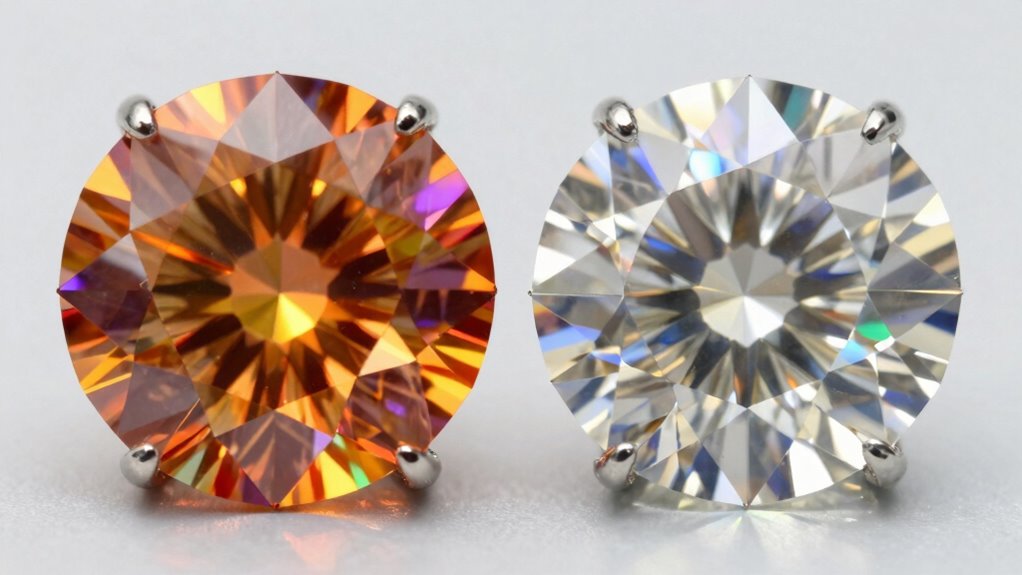

When comparing moissanite and diamond, you’ll notice that moissanite offers more fire and vibrant brilliance due to its higher refractive index, making it stand out with lively, rainbow-like sparkles. Diamonds, however, provide a subtle, refined sparkle focused on clarity and depth. Regarding durability, diamonds are slightly harder and more scratch-resistant, but moissanite still holds up well for daily wear. To discover more about their unique qualities, keep exploring the differences that make each stone special.
Key Takeaways
- Moissanite exhibits more fire (rainbow dispersion) than diamonds, creating a vibrant and lively sparkle.
- Diamonds offer a subtle, refined brilliance focused on clarity and depth, contrasting with moissanite’s fiery display.
- Both stones are highly durable, with diamonds rated 10 and moissanite at 9.25 on the Mohs scale, suitable for daily wear.
- Moissanite’s high refractive index enhances its sparkle, often appearing more dazzling than the softer brilliance of diamonds.
- While diamonds are slightly more scratch-resistant, both stones are durable enough for regular jewelry use.
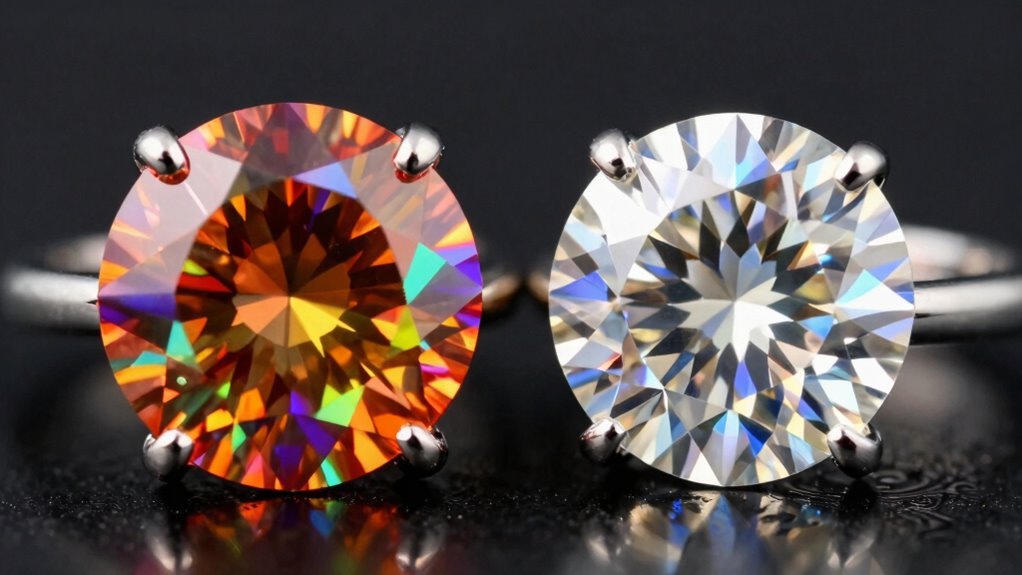
When choosing between moissanite and diamond, understanding their differences can help you make an informed decision. One of the first things to consider is their color variations. Diamonds are graded on a scale from D (colorless) to Z (light yellow or brown). High-quality diamonds tend to be nearly colorless, offering a classic, clear look. Moissanite, on the other hand, often displays a subtle fire that can sometimes give it a slightly different hue, especially under certain lighting conditions. While some people prefer the cooler, more traditional appearance of a diamond, others find moissanite’s slight color play charming. It’s important to look at both stones in person, as the differences can be more noticeable in direct light.
Diamonds are graded from D to Z, while moissanite shows subtle fire and hue variations under different lighting.
Price comparison is another essential factor. Moissanite is considerably more affordable than diamonds, making it an excellent choice if you want a large, eye-catching stone without breaking the bank. You can often purchase a moissanite that’s similar in size and appearance to a high-quality diamond at a fraction of the cost. This price difference allows you to prioritize size or design details that might be limited by a more expensive diamond budget. If budget is a concern, moissanite offers incredible value, allowing you to have a stunning ring that looks luxurious without the hefty price tag.
When it comes to fire and brilliance, both stones perform well, but with some distinctions. Moissanite is renowned for its exceptional sparkle, often exhibiting more fire than a diamond. Its high refractive index causes it to disperse light into a rainbow of colors, making it incredibly eye-catching. Diamonds, while still brilliant, tend to have a more subtle sparkle, with a focus on clarity and depth. The brilliance of a diamond is often considered more natural and refined, but if you’re drawn to a more vibrant, fiery display, moissanite might be your preferred choice. Additionally, biodiversity and sustainable options are increasingly important considerations for many buyers, making moissanite’s eco-friendly origin an appealing factor. Furthermore, the ethical sourcing of moissanite can be a significant advantage for conscious consumers.
Durability is also an important consideration. Diamonds are the hardest naturally occurring substance, rated 10 on the Mohs scale, making them highly resistant to scratches and damage. Moissanite, rated slightly lower at 9.25, is still extremely durable and suitable for everyday wear. While both stones withstand daily activities well, diamonds have a slight edge in longevity and scratch resistance.
In the end, your choice depends on what qualities matter most to you—whether it’s the subtle nuances of color, impressive fire, price, or durability. Both stones can create beautiful, memorable jewelry, but knowing their differences helps you select the perfect piece for your style and needs.
As an affiliate, we earn on qualifying purchases.
Frequently Asked Questions
How Does Moissanite’s Price Compare to Diamonds?
Moissanite is considerably more affordable than diamonds, usually costing about 10-20% of a diamond’s price. Pricing fluctuations are less common for moissanite, thanks to stable market availability and consistent production. This makes it an attractive option if you’re seeking a beautiful, durable gemstone without breaking the bank. You’ll find that moissanite offers a great balance of quality and affordability, especially compared to the often higher prices of natural diamonds.
Can Moissanite Develop a Yellow Tint Over Time?
A stitch in time saves nine—so, you should know that moissanite generally won’t develop a yellow tint over time. It boasts excellent color stability, maintaining its appearance for years, and offers high visual clarity. While some low-quality moissanites might show slight color changes if exposed to harsh conditions, most durable stones stay vibrant and true, making them a smart, long-term choice for your jewelry.
Are Moissanites Ethically Sourced More Than Diamonds?
Yes, moissanites are generally more ethically sourced than diamonds, as they are created in labs, avoiding issues related to unethical mining practices. This process reduces environmental impact and supports ethical mining standards. When you choose moissanite, you’re opting for a gemstone with a lower ecological footprint and fewer concerns about human rights violations often associated with diamond mining. This makes moissanite a more responsible and eco-friendly choice for your jewelry.
How Do Moissanite and Diamond React to Everyday Chemicals?
You might be surprised how both moissanite and diamond react to everyday chemicals. Generally, they’re quite resistant, making cleaning methods simple. However, strong chemicals like bleach or acids can damage or dull their surfaces over time. To keep your jewelry sparkling, avoid harsh cleaners and stick to gentle soap and water or mild jewelry solutions. This way, you preserve their brilliance without risking chemical damage.
Is Moissanite Suitable for All Types of Jewelry?
Yes, moissanite is suitable for all types of jewelry due to its great jewelry versatility and fashion suitability. You can confidently wear it in rings, earrings, pendants, or bracelets, as it complements various styles and occasions. Its durability guarantees it withstands daily wear, making it a practical choice. Whether for casual or elegant looks, moissanite’s brilliance and resilience make it an excellent option for diverse jewelry pieces.
Conclusion
Ultimately, whether you choose moissanite or diamond depends on what sparkles most in your eye. Both possess their unique charm—one with fiery brilliance, the other with timeless durability. Think of it as a dance between fire and resilience, each shining in its own right. So, when you pick your gemstone, remember, it’s not just about what catches the eye, but what captures your heart. After all, a true gem reflects the soul that wears it.